Quick Summary
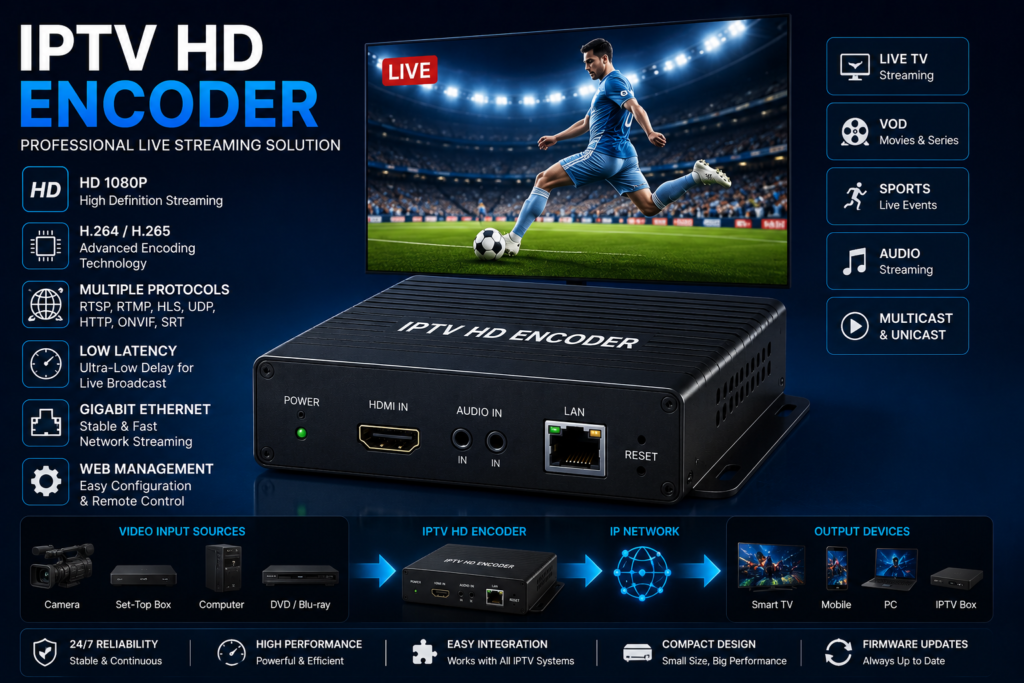
An IPTV HD encoder is a professional device that converts HDMI, SDI, or AV video signals into compressed digital streams for IPTV networks. It enables broadcasters, hotels, schools, businesses, and content creators to deliver high-definition live video over IP with excellent image quality, low latency, and reliable performance.
What Is an IPTV HD Encoder?
An IPTV HD encoder is a hardware encoder designed to capture HD video from various sources and convert it into IPTV-compatible streaming formats such as H.264 (AVC) or H.265 (HEVC).
Instead of sending video directly to a display, the encoder compresses the signal and streams it over an IP network using protocols like:
- RTSP
- RTMP
- HLS
- HTTP
- UDP
- RTP
- SRT (supported on many professional models)
This allows viewers to watch live HD content on Smart TVs, computers, mobile devices, IPTV boxes, and other compatible platforms.
How Does an IPTV HD Encoder Work?
An IPTV HD encoder follows a simple workflow:
- Connect a video source such as a camera, satellite receiver, DVR, media player, or computer.
- The encoder captures the HD video and audio.
- It compresses the content using H.264 or H.265 encoding.
- The encoded stream is transmitted through your local network or the internet.
- IPTV middleware or compatible players receive and display the stream on connected devices.
This process enables efficient live broadcasting while maintaining high-definition picture quality.
Why Use an IPTV HD Encoder?
An IPTV HD encoder provides a professional solution for delivering HD video across IPTV networks.
Major advantages include:
- Crystal-clear HD video quality
- Efficient video compression
- Lower bandwidth consumption
- Low-latency streaming
- 24/7 continuous operation
- Multiple streaming protocol support
- Easy integration with IPTV systems
- Remote web management
- High reliability
These benefits make HD encoders ideal for professional IPTV deployments.
Common Applications of IPTV HD Encoders
IPTV HD encoders are used in a wide variety of industries.
Television Broadcasting
Broadcast HD television channels over IPTV with stable performance and excellent picture quality.
Hotels and Hospitality
Distribute live TV channels and promotional content to guest rooms using existing network infrastructure.
Education
Schools and universities stream lectures, seminars, and training sessions to classrooms and remote students.
Sports Broadcasting
Deliver live sporting events in high definition with low latency and reliable streaming.
Corporate Communications
Broadcast company meetings, conferences, and training sessions across multiple offices.
Houses of Worship
Stream religious services to local and global audiences in high-definition quality.
Key Features of an IPTV HD Encoder
When selecting an IPTV HD encoder, consider the following features:
- HD 720p and 1080p support
- HDMI or SDI input
- H.264/H.265 video encoding
- AAC audio encoding
- Multiple simultaneous streams
- Gigabit Ethernet
- Low-latency encoding
- Web-based configuration
- Remote firmware updates
- Stable 24/7 operation
These features help ensure reliable performance for professional IPTV broadcasting.
IPTV HD Encoder vs IPTV 4K Encoder
| Feature | IPTV HD Encoder | IPTV 4K Encoder |
|---|---|---|
| Resolution | Up to 1080p | Up to 4K UHD |
| Bandwidth Usage | Lower | Higher |
| Hardware Cost | More Affordable | Higher |
| Streaming Quality | Excellent | Ultra HD |
| Network Requirements | Moderate | High-Speed Required |
| Best For | Most IPTV Systems | Premium Broadcasting |
For many IPTV networks, HD encoders provide the ideal balance between quality and bandwidth efficiency.
Supported Streaming Protocols
Professional IPTV HD encoders typically support:
- RTSP
- RTMP
- HLS
- HTTP
- RTP
- UDP
- SRT
- ONVIF (selected models)
Supporting multiple protocols ensures compatibility with various IPTV middleware platforms and streaming applications.
Internal Resources
- https://bieniptv.com/setup/
- https://bieniptv.com/channels-list/
- https://bieniptv.com/pricing/
- https://bieniptv.com/contact/
Trusted External Resources
- https://www.hdmi.org/
- https://www.w3.org/
- https://www.internetsociety.org/
- https://www.srtalliance.org/
How to Choose the Best IPTV HD Encoder
Choosing the right IPTV HD encoder is essential for delivering reliable, high-quality live video. While many models offer similar specifications, professional encoders provide better stability, lower latency, and greater compatibility with IPTV platforms.
Video Resolution
Before purchasing an encoder, determine the maximum resolution you need.
Most IPTV HD encoders support:
- 720p HD
- 1080p Full HD
- 1080p60 for smoother motion
If your current project only requires HD broadcasting, a dedicated HD encoder is often more cost-effective than a 4K model.
Video Compression
Modern IPTV HD encoders usually support one or both of these codecs:
H.264 (AVC)
- Excellent compatibility
- High image quality
- Lower hardware requirements
- Widely supported by IPTV platforms
H.265 (HEVC)
- Better compression efficiency
- Lower bandwidth consumption
- Improved streaming performance
- Ideal for large IPTV deployments
Choosing the right codec depends on your IPTV infrastructure and playback devices.
Network Connectivity
Reliable network performance is critical for uninterrupted streaming.
Look for features such as:
- Gigabit Ethernet
- Adaptive bitrate
- Constant Bitrate (CBR)
- Variable Bitrate (VBR)
- Low-latency streaming
These features help maintain stable video quality even during heavy network traffic.
Remote Management
Professional IPTV HD encoders include a web-based management interface that allows administrators to:
- Configure encoding settings
- Monitor system status
- Update firmware
- Restart the device remotely
- Manage multiple encoders
Remote management saves time and simplifies maintenance for larger IPTV installations.
Benefits of Using an IPTV HD Encoder
An IPTV HD encoder provides several important advantages.
These include:
- High-definition video quality
- Low-latency broadcasting
- Efficient bandwidth usage
- Continuous 24/7 operation
- Reliable network streaming
- Easy IPTV integration
- Professional-grade performance
- Multi-protocol support
- Remote monitoring and configuration
These features make IPTV HD encoders suitable for both small and large streaming environments.
Common IPTV HD Encoder Applications
Professional IPTV HD encoders are used across many industries.
Popular applications include:
- Television broadcasting
- Hotels and hospitality
- Educational institutions
- Corporate communications
- Houses of worship
- Live event production
- Sports broadcasting
- Healthcare facilities
- Government organizations
- Digital signage networks
Their flexibility allows organizations to deliver high-definition video to thousands of viewers simultaneously.
Frequently Asked Questions
What is an IPTV HD encoder?
An IPTV HD encoder converts HD video and audio into IPTV-compatible IP streams for live broadcasting over local networks or the internet.
What video sources are supported?
Most encoders support HDMI, SDI, AV, or VGA inputs depending on the model.
Does an IPTV HD encoder support Full HD?
Yes. Most professional models support 1080p Full HD streaming with excellent image quality.
Is H.265 better than H.264?
H.265 generally provides better compression, allowing similar image quality while using less bandwidth.
Can one encoder stream to multiple users?
Yes.
A single IPTV HD encoder can distribute streams to hundreds or thousands of viewers when connected to an appropriate IPTV server.
Do I need IPTV middleware?
Not always.
Many encoders can stream directly using RTSP, RTMP, HLS, or UDP. However, IPTV middleware provides additional management features and simplifies channel organization.
Is an IPTV HD encoder suitable for 24/7 broadcasting?
Yes.
Professional-grade encoders are designed for continuous operation in demanding environments.
Which industries benefit most?
Industries commonly using IPTV HD encoders include:
- Broadcasting
- Hospitality
- Education
- Healthcare
- Government
- Corporate communications
- Sports production
Future of IPTV HD Encoders
The IPTV industry continues to evolve with improvements in encoding technology.
Modern IPTV HD encoders now offer:
- AI-assisted video optimization
- Lower latency
- Enhanced H.265 encoding
- Better remote management
- Improved security
- Cloud integration
- Higher reliability
These innovations make IPTV broadcasting more efficient and scalable than ever before.
Conclusion
An IPTV HD encoder is an essential component of any professional IPTV broadcasting system. It delivers high-definition video, efficient compression, reliable network streaming, and seamless integration with IPTV platforms.
Whether you’re broadcasting television channels, streaming educational content, managing hotel TV systems, or delivering live events, investing in a quality IPTV HD encoder ensures consistent performance and an excellent viewing experience.
Call to Action
Build a Professional IPTV Streaming Solution
Looking for reliable IPTV services and streaming resources?
Discover professional IPTV solutions, setup guides, and expert support to create a high-performance IPTV network.
👉 Visit: https://bieniptv.com/
👉 Setup Guide: https://bieniptv.com/setup/
👉 Contact Us: https://bieniptv.com/contact/